Demand can make a product visible before its evidence chain is ready.
Dubai-style chocolate is not the point. The control system around a fast-moving product is.
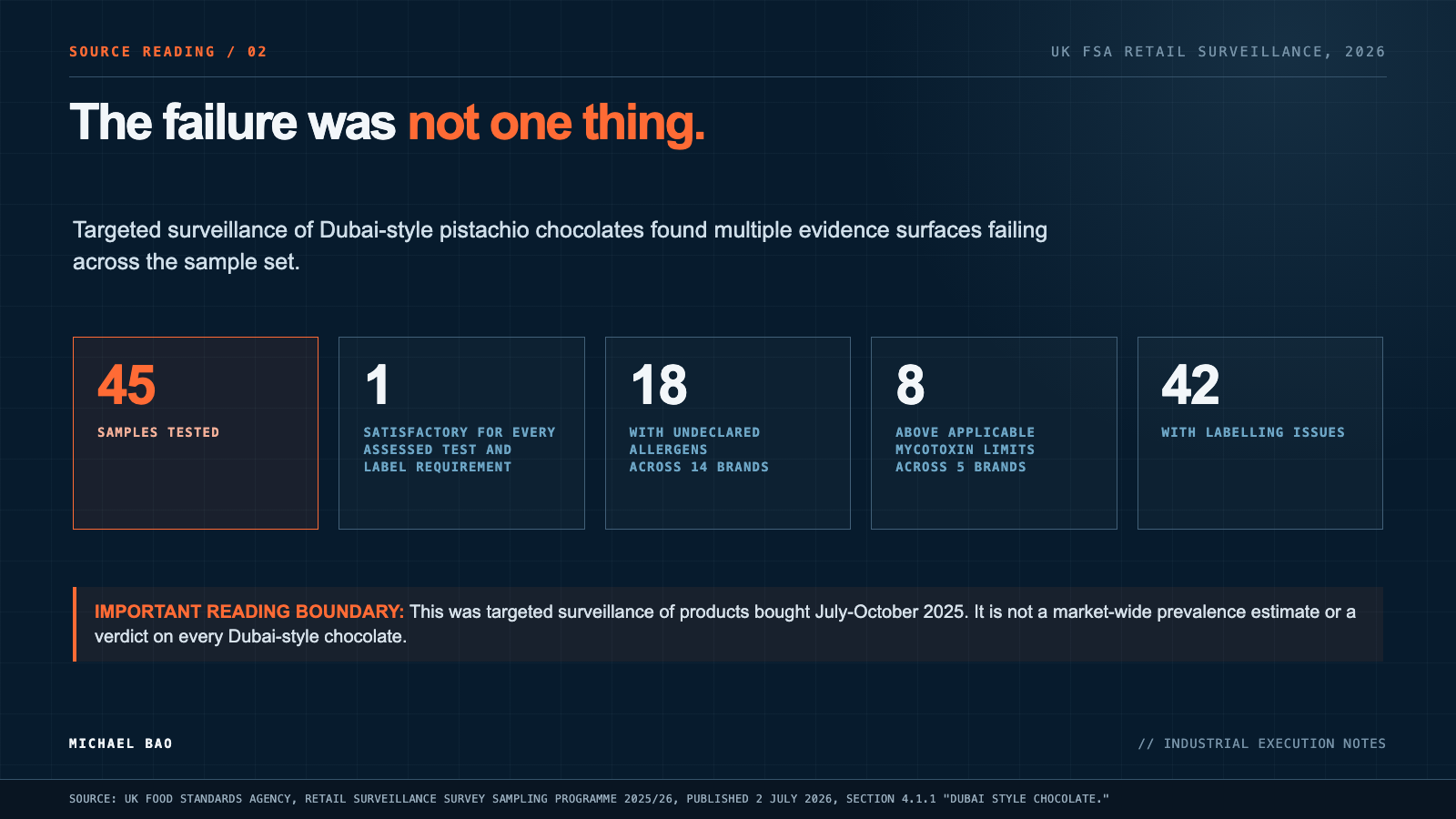
In July 2026, the UK Food Standards Agency published results from a targeted retail surveillance programme. The programme tested 45 Dubai-style pistachio chocolates purchased between July and October 2025. Only one was satisfactory for every test and labelling requirement assessed.
The results need to be read carefully. This was targeted surveillance, not a measurement of the whole market. It does not say every product in the category is unsafe. But it is a useful case because the failures were not one thing.
The report recorded undeclared allergens in 18 chocolates across 14 brands, mycotoxin results above the applicable limits in eight samples across five brands, and labelling issues in 42 of the 45 samples. In 12 cases, a labelling failure was the only reason a sample was judged unsatisfactory.
That is not a story about one bad ingredient. It is a story about a product becoming several different products as it moves through a market.
A trend does not have one identity
When teams talk about a trend product, they often mean one thing: the concept consumers want.
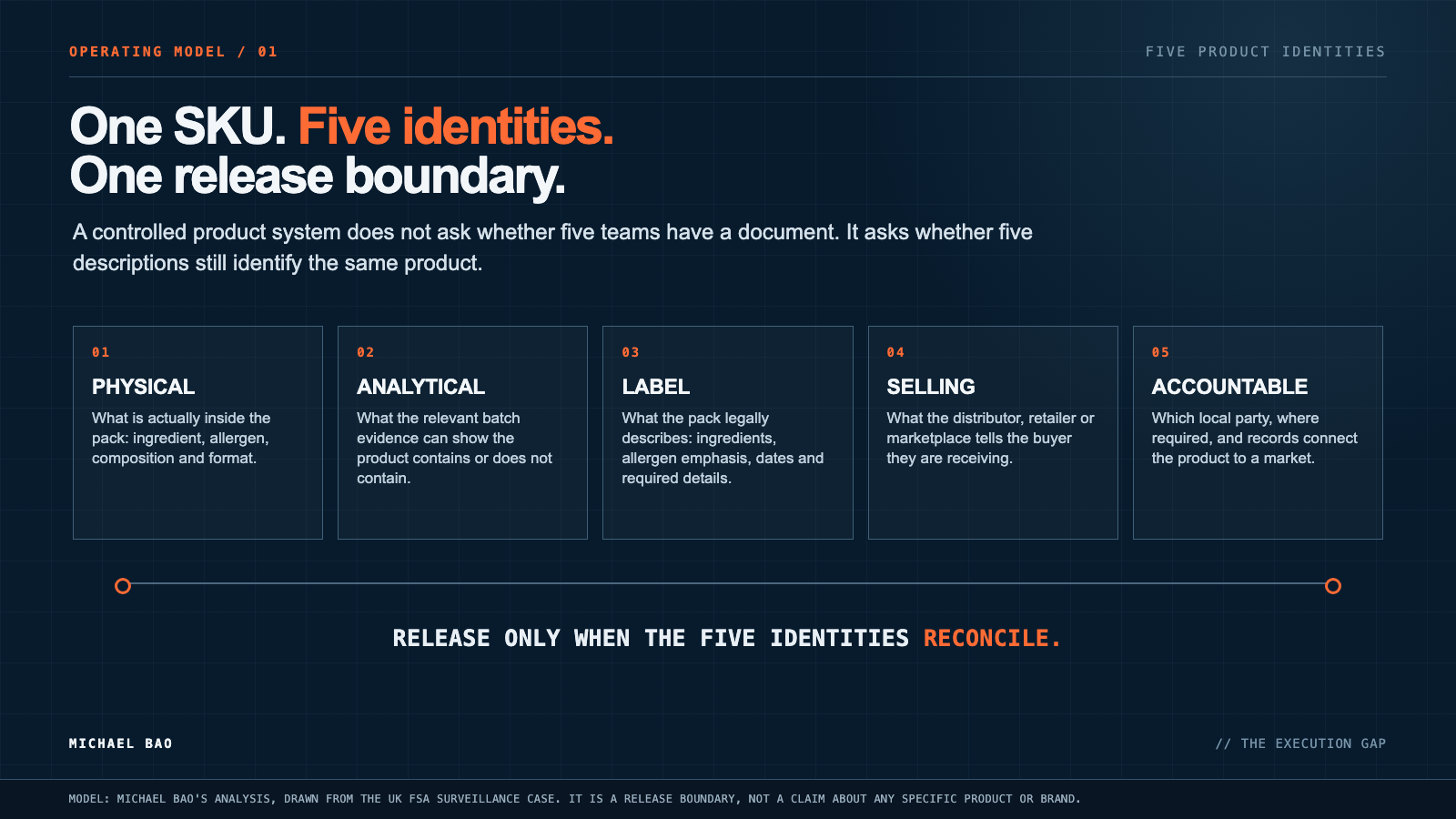
But a product crossing a border, a marketplace or a scale-up phase carries more than a concept. It carries at least five identities.
The physical identity is what is actually in the pack: ingredients, allergens, composition and format.
The analytical identity is what the batch can be shown to contain, or not contain, through relevant testing and retained evidence.
The label identity is the legal description on the pack: ingredients, allergen emphasis, durability information, importer details and other required information.
The selling identity is what the retailer, distributor or marketplace says the consumer is buying.
The accountable identity is the local business or importer, where the destination market requires one, whose name and records connect the product to that market.
In a controlled product system, these identities describe the same object.
They do not always drift at the same time. A batch can be analytically acceptable while the online listing is incomplete. A correct formulation can reach a shelf with an inadequate allergen statement. A package can look finished while the importer information is absent or unclear.
That is why the relevant question is not "is the product popular?" The hard part is whether the market can still identify, test, describe and hold the same product accountable.
What the FSA case actually shows
The FSA samples were selected because Dubai-style chocolate was a trend-driven commodity. Sampling focused on places where it was commonly sold, including small food businesses, discount stores, online retailers and marketplaces. Most samples were imported products or products from smaller brands.
That selection matters. It means the findings are not a prevalence rate for all chocolate or all Dubai-style chocolate. They are a map of what targeted monitoring found in a higher-risk retail environment.
Still, the pattern is commercially important.
The report found that nine samples had findings across every assessed area: allergens, contaminants and labelling. It also noted that online purchases can create their own information gap. In 14 cases elsewhere in the programme, precautionary allergen labelling was visible only after the product arrived, not at the time of online purchase.
The product did not suddenly become complicated when a laboratory opened the package. It was already complicated at the point of sale. The laboratory made the mismatch visible.
Demand is a signal. It is not a release decision.
This matters most when a brand sees a category moving quickly and decides to copy the format, source it quickly or add it to a distributor's portfolio.
Fast demand creates an understandable commercial pressure: secure the ingredient, approve the artwork, list the SKU and make the product available before the trend moves on.
Those are all legitimate commercial actions. But a product should not gain a new market merely because it has gained a new sales channel.
For commercial teams, the five identities form a practical release-control model. Subject to the destination market's legal requirements, they should be reconciled around the same SKU and, where relevant, the same batch before release into a new market:
- Does the current pack describe the actual ingredient and allergen reality?
- Is there evidence appropriate to the risk that can be connected to the product being released?
- Does the marketplace or distributor listing say the same thing as the physical pack?
- Is the local responsible party identifiable from the documents and the product information?
- If a regulator asks what this product is, can one file set answer without reconstructing the story from several suppliers?
This is not a substitute for legal advice, food-safety systems or product testing. It is a practical release boundary for the commercial team: if the product cannot be reconciled across these identities, it may not yet be ready as a repeatable market product.
The commercial cost arrives later
The usual mistake is to see compliance evidence as a cost that follows launch.
It does not follow launch. It determines whether launch can survive repeat orders, a platform review, a retailer request, an import question or a product complaint.
The point is not to slow a trend product until it misses the market. The point is to know which evidence must travel at the same speed as demand.
Some of that evidence sits with the manufacturer. Some sits with the ingredient supplier, the label owner, the importer or the platform operator. The commercial arrangement can distribute the work. It cannot remove the need for the identities to agree.
For cross-border teams, this is often the first real due-diligence question. Not "can we sell this product?" but "when it is sold, whose version of the product is the market seeing?"
Virality is a demand signal. It is not a release decision.