
A clean purchase order is not a qualified lot
In Issue #010, we looked at what happens after a recall notice reaches the market and why local inventory codes often fail to connect to retail pack dates. This week, we move one step upstream to the moment goods are sourced and bought.
Enterprise procurement software is undergoing a genuine shift. For years, ERP systems functioned mainly as passive ledgers: they recorded the final invoice price after a human buyer negotiated terms over email and phone. Now, AI procurement agents are turning those ledgers into active verification systems.
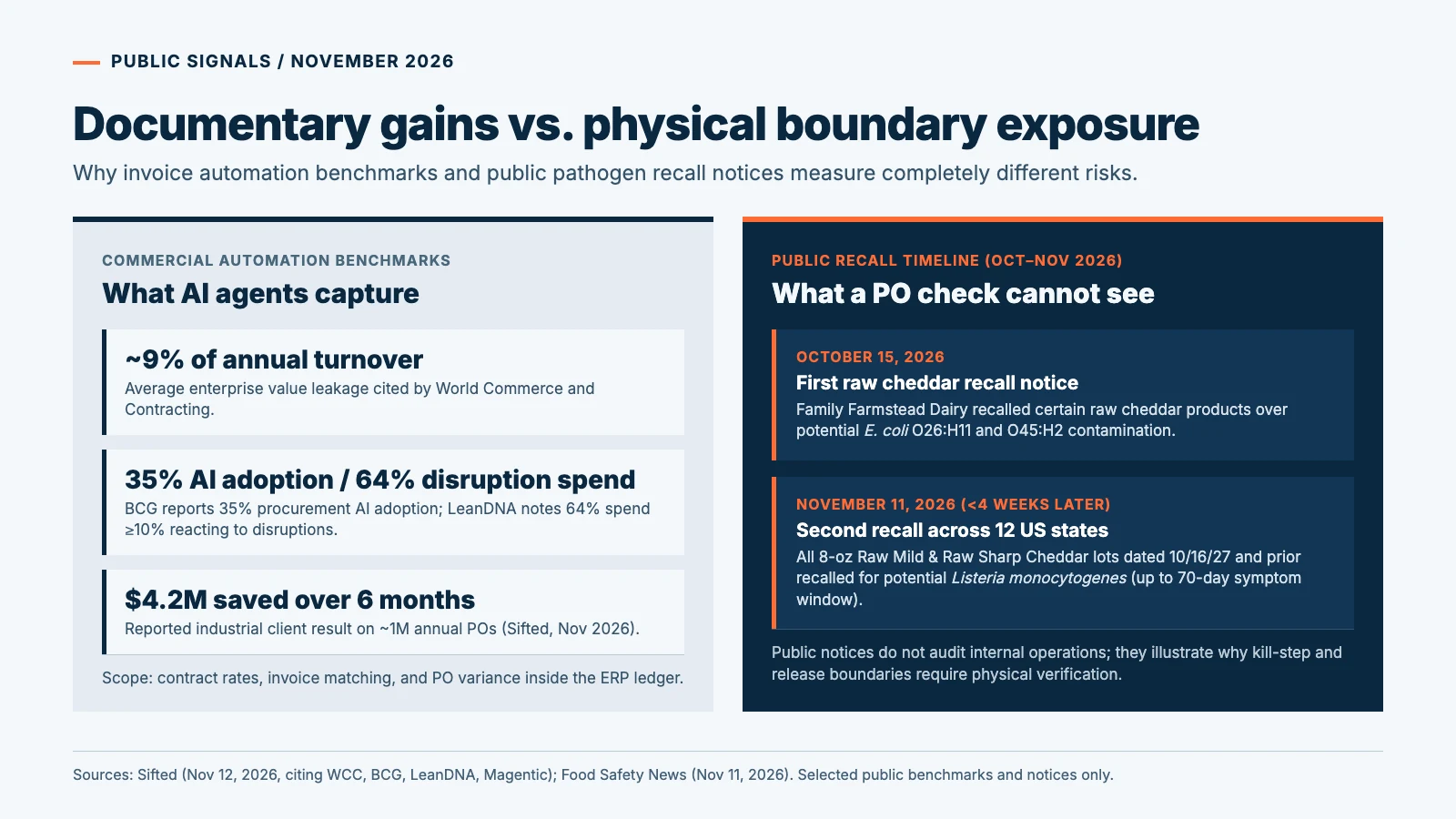
According to World Commerce and Contracting, enterprises lose roughly 9 percent of annual turnover to value leakage through overpayments, missed terms, and uncaptured savings. Meanwhile, Boston Consulting Group reports that only 35 percent of procurement teams have adopted AI, even as LeanDNA notes that 64 percent of manufacturers spend 10 percent or more of their budget reacting to supply-chain disruptions.[1]
That commercial gap is why startups such as Magentic are gaining traction across automotive, oil and gas, and food and beverage manufacturing. As Sifted reported in November 2026, AI agents read emails, supplier documents, and CAD drawings to reconcile pricing against purchase orders automatically. On roughly one million purchase orders per year, one client saved 1.2 million US dollars in three months and 4.2 million US dollars over six months.[1]
Those savings are real. Yet they govern the commercial ledger, not the factory floor.
What documentary verification cannot see
An AI procurement agent excels at documentary consistency, and modern agents go well beyond checking whether a PDF arrived. When contracts require structured, checkable formats, software can match lot-level Certificates of Analysis and batch records to an advance shipping notice (ASN), compare reported values against specification limits, and automatically hold receipt or payment when data is missing or out of spec.
That is a real transactional control. The boundary sits at what the document represents, not how fast software reads it.
An agent can verify that the numbers printed on a COA fall inside specification. It cannot verify that the sample pulled for that test truly represents the physical lot sitting on the truck, that a pasteurizer held its validated thermal kill-step, that sanitation and environmental monitoring stayed in control, or that finished goods were held until microbiological clearance came back clean.
When teams mistake automated document-to-spec checks for end-to-end supply assurance, they leave a structural gap between what passed on paper and what was actually safe to ship.
A November recall illustrates the physical boundary
Public food-safety notices from the same week in November 2026 show why that distinction matters.
On November 11, Food Safety News reported that Family Farmstead Dairy recalled all of its raw cheddar cheese products, covering 8-ounce plastic-wrapped Raw Mild Cheddar and Raw Sharp Cheddar across lot codes dated 10/16/27 and prior. The recalled cheese had been distributed through retail stores across 12 US states: New York, New Jersey, Vermont, New Hampshire, Maryland, Pennsylvania, Rhode Island, Connecticut, Delaware, Virginia, West Virginia, and Tennessee.[2]
The notice cited potential contamination with Listeria monocytogenes, an organism whose infection symptoms can take up to 70 days to appear after exposure and which poses heightened risk to pregnant women, older adults, young children, and immunocompromised individuals.
Just as important, this was the company's second recall in four weeks. On October 15, 2026, it had recalled certain raw cheddar products over potential contamination with E. coli O26:H11 and O45:H2.[2]
For any operation handling unpasteurized or minimal-kill-step products, two pathogen recalls in four weeks point to the same structural reality: without a validated kill-step and enforced release gates, contamination exposure can spread across states and weeks of shelf life.
No AI agent reconciling purchase orders, invoices, or supplier-submitted paperwork would have surfaced that physical-process exposure on its own.
Public signals / November 2026
Separating the commercial plane from the physical plane
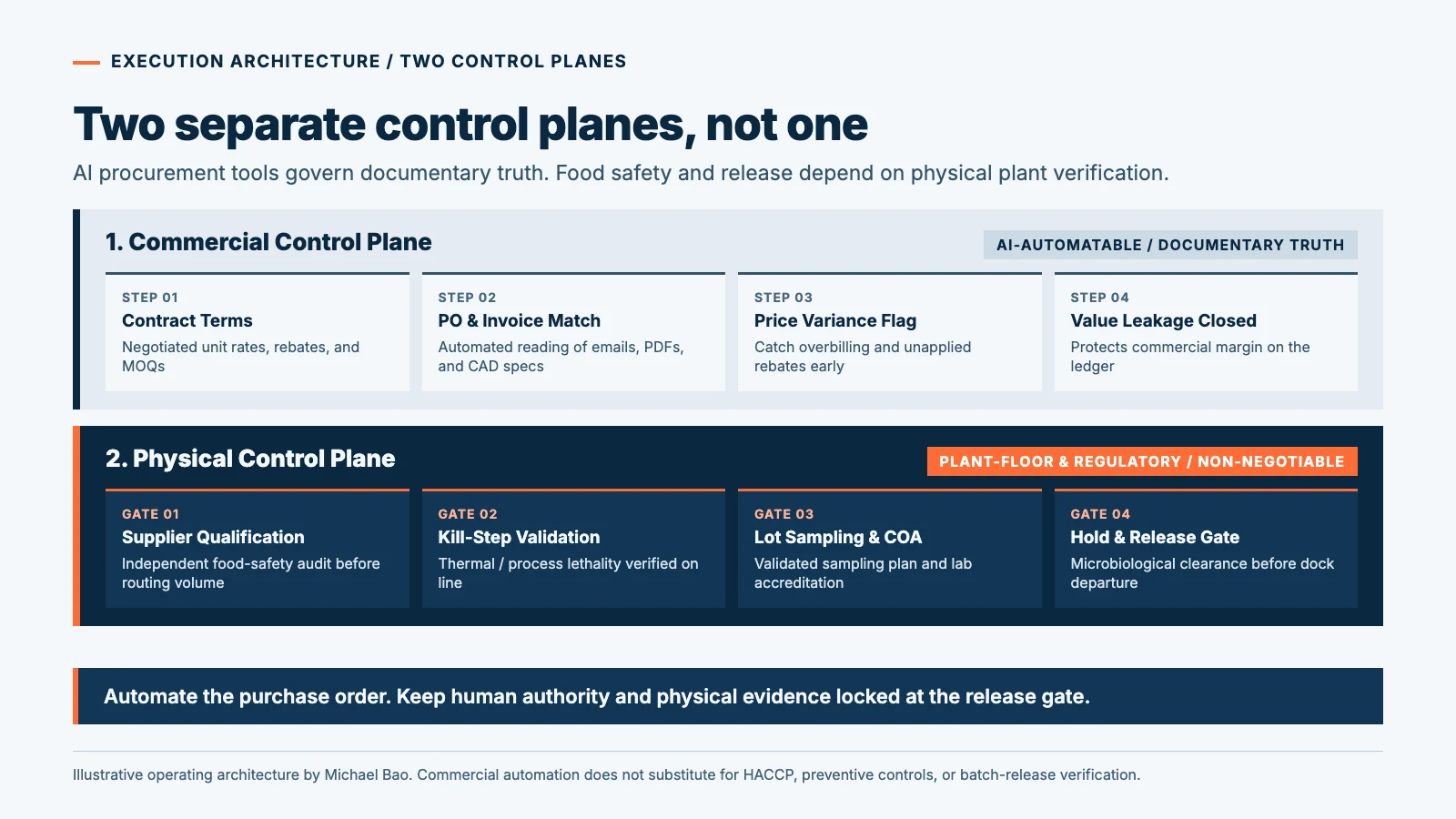
Every physical-goods business operates on two separate control planes that require different tools and different owners:
Control architecture
- 1. Commercial control plane
- Contract terms, purchase-order matching, price variance, rebate enforcement, and automated document-to-spec holds. Documentary and highly suited to AI automation.
- 2. Physical control plane
- Supplier qualification, kill-step validation, lot-level sampling, microbiological release gates, and downstream traceability. Physical, regulatory, and non-negotiable.
Closing 9 percent value leakage on the first plane strengthens unit economics. Failing on the second plane triggers multi-state recalls, retail delistings, and regulatory holds that can erase years of procurement savings overnight.
Execution architecture / Two control planes
Four guardrails for AI-assisted food sourcing
Teams adopting AI procurement agents in food, beverage, or nutrition supply chains should pair their software deployment with four physical guardrails:
Before deploying sourcing automation
- 1. Decouple price routing from qualification
- Never let an automated sourcing rule shift volume to a lower-cost or backup vendor until food-safety audits and kill-step validations are independently verified.
- 2. Verify hold-and-release discipline
- Confirm that a supplier holds finished lots pending laboratory clearance rather than shipping immediately and relying on post-shipment recalls.
- 3. Contract for checkable lot-level records
- Invoice item codes and pack-level lot dates often live in separate databases. Require structured, lot-linked COAs tied to specific laboratory test scopes in the contract so agents can enforce receipt and payment holds while quality teams verify physical sampling.
- 4. Retain human stop-ship authority
- AI agents can surface anomalies in seconds, but an accountable quality or operations leader must retain explicit authority to hold shipment whenever process evidence is incomplete.
The handoff
Software is finally solving the commercial friction inside procurement. That is welcome progress for manufacturing margins.
Still, a purchase order only proves that two parties agreed on a price. Physical verification is what proves the product is safe to release.
Key boundary
Automate commercial matching and structured document-to-spec holds on the transaction ledger, never physical qualification, sampling integrity, or batch-release sign-off on the plant floor.
Strategy is the commercial intent. The supply chain is the grounded reality.
Evidence & reading
Sources and scope
- Sifted. 12 November 2026. How AI is changing procurement and supply chains (reporting on Magentic, World Commerce and Contracting, BCG, and LeanDNA benchmarks). Read source →
- Food Safety News. 11 November 2026. Family Farmstead recalls more raw cheese; this time because of Listeria (referencing the 11 November 2026 Listeria recall across 12 states and the 15 October 2026 E. coli recall). Read source →
Originally published in The Execution Gap #011 (19 November 2026); updated for the web edition.