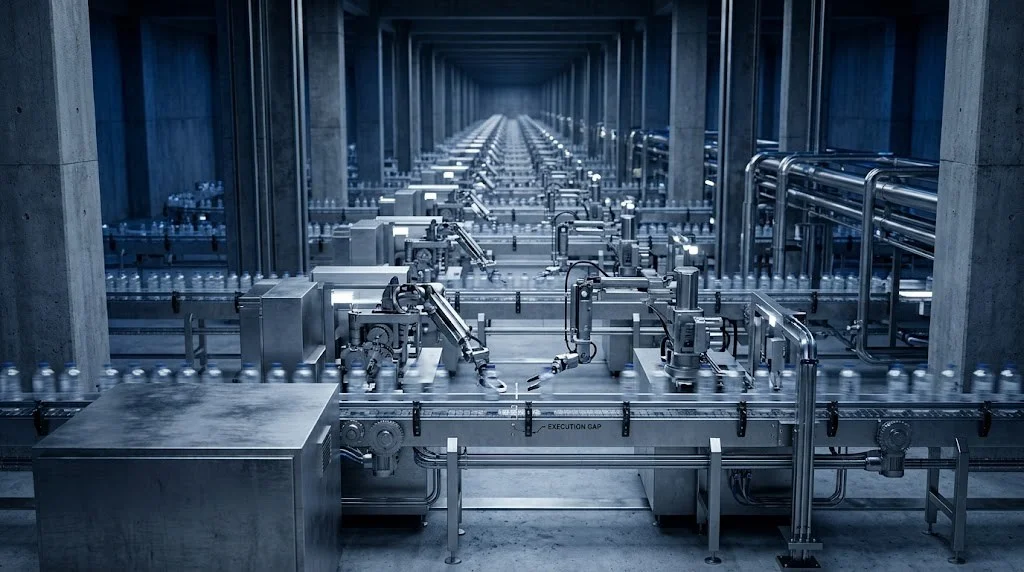
Decoupling Commercial Valuation from Manufacturing Volatility.
AUTHOR // Michael Bao
STATUS // Public Brief
Executive Summary
Ninety percent of boardroom innovations fail not because of flawed strategy, but because the commercial intent collides with the unyielding physical reality of the global manufacturing ecosystem.
Whether you are scaling precision fermentation to 50,000 liters, or integrating a high-protein UHT beverage—the point of failure is rarely chemical. It is structural. This V2.0 blueprint details Strategic Vendor Architecture (SVA)—the definitive physical defense OS required to bridge the execution gap.
"You cannot audit paperwork only; you must audit the physics. Strategy is the commercial intent. The supply chain is the grounded reality."
1. The Symptoms of Structural Fragility
The legacy transactional vendor-selection model assumes that a chemically compliant Certificate of Analysis (COA) equals manufacturing security. This is a structural cognitive trap. A COA is a static snapshot that cannot detect process deviations under commercial pressure or the physics of scale.
We witness this systemic fragility fracturing business models across three distinct vectors:
The Thermodynamic Wall: Physics does not scale linearly. Misaligned mechanical shear or thermal mass during scale-up can physically incinerate bio-active efficacy. This is particularly lethal when removing artificial stabilizers for Clean Label compliance, or transitioning microbial fermentation to 50,000L industrial bioreactors, even when laboratory assays remain perfect[1][2][3].
Sub-Tier Opacity & IP Leakage: Auditing your Tier-1 "Master OEM" is a necessary baseline, but it remains structurally insufficient. The real liabilities—unannounced processing shifts, sub-tier adulteration, and devastating intellectual property (IP) theft via reverse-engineering—occur hidden within unvetted Tier-2 extraction nodes and unified manufacturing architectures[4][5].
Macro-Friction & PE Illusions: When Private Equity (PE) capital mandates artificially squeeze working capital and consolidate vendors to spike short-term EBITDA, the lack of SVA redundancy triggers severe supply cliffs the moment geopolitical logistics (e.g., Hormuz transit) are disrupted[6].
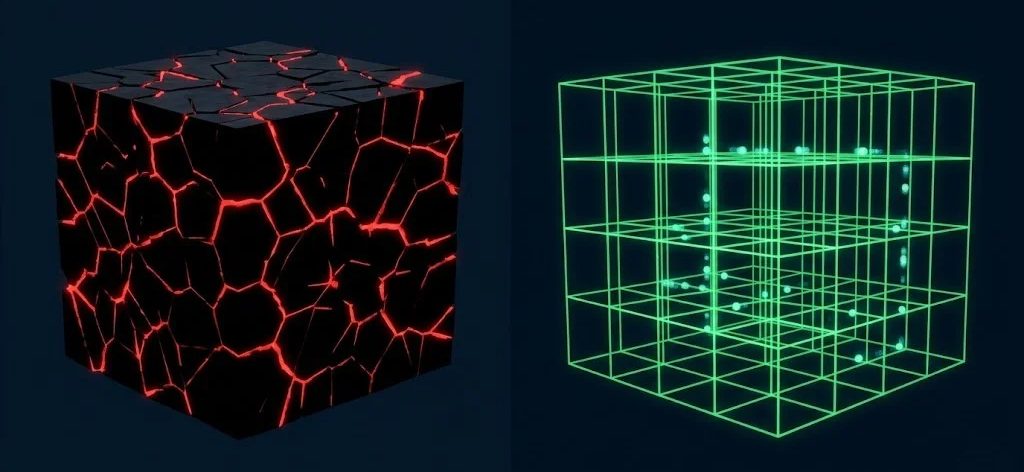
Figure 1: Structural Comparison - Legacy Fragmentation vs. SVA Integration Matrix.
2. The SVA Operating System (The 3 Pillars)
Strategic Vendor Architecture replaces paper-based trust with a three-dimensional physical defense matrix. It is the architectural firewall for your commercial valuation.
01TPI Locking (Physics Alignment)
The Thermodynamic Parity Index (TPI) measures the mathematical alignment between factory machinery stress (kLa, mechanical shear, hydrostatic pressure) and formulation tolerance. SVA mandates explicit physical validation before commercial scaling begins.
02Sub-Tier Structural Transparency
Penetrating the invisible Tier-2 ecosystem. SVA refuses end-of-batch static data. The protocol demands real-time SCADA log mirroring for critical thermal control points, preventing source nodes from silently altering thermodynamics to inflate yields.
03Anti-Bypass Architectural Moat
Dismantling the "Master OEM" vulnerability via Strategic Fragmentation. We do not promise magical invulnerability; we engineer maximum structural friction. By physically decoupling critical upstream compounding from final mass assembly, sensitive inputs arrive at the terminal factory as Proprietary Intermediates.
While fully compliant with global traceability regulations, the macro-level COAs of these intermediates obscure the micro-formulation ratios and the upstream thermodynamic processes. We fragment the total SOP so no single node holds the complete blueprint. Even if a final-stage manufacturer attempts to reverse-engineer the product, they lack the upstream TPI keys, elevating the barrier of casual IP theft into highly complex industrial espionage.
SVA INTEGRATION STACK
Figure 2: Routing commercial intent through the SVA layer to safely bypass the systemic execution gap.
The manufacturing floor does not care about your burn rate or your 100-day value creation plan. Success requires accepting that a 0.5% variance in raw material thermodynamics can completely block a 10,000-liter-per-hour production line. Scale is the final output of a stabilized system.
Strategy is the top-level concept. Manufacturing is the physical reality.
Fact-Check Sources
Core Framework References
Garcia-Ochoa, F., & Gomez, E. (2009). Bioreactor scale-up and oxygen transfer rate in microbial processes: an overview. Biotechnology Advances, 27(2), 153-176. (Critical analysis of kLa collapse in fermentation).
Lund University. (2016). Cleaning of ultra-high temperature milk fouling. Mechanical & Chemical Engineering Diagnostics. (Diagnostics on thermal denaturation in UHT high-protein matrices).
Journal of Food Engineering. (2023). Rheological and thermodynamic impacts of hydrocolloid replacement in clean-label matrices. (Validating the physical destabilization triggered by removing chemical stabilizers).
U.S. Food and Drug Administration (FDA). (2025). Warning Letters Directory: Analysis of Data Integrity and Process Validation Failures in Cross-border API Facilities.
U.S. International Trade Commission (USITC). (2026, March). Notice of Institution of Investigation: Certain Beverage Brewing Capsules (Inv. No. 337-TA-1485). (Legal precedent confirming massive IP leakage and Trade Secret Misappropriation via un-isolated OEM networks).
Gartner Supply Chain Practice. (2025). The Fragility of Lean Procurement: Why EBITDA-driven Vendor Consolidation Destroys Resilience in Geopolitical Crises.
Bao, M. (2026). The Strategic Vendor Architecture (SVA) Blueprint V2.0. Independent Global Supply Chain OS Framework.