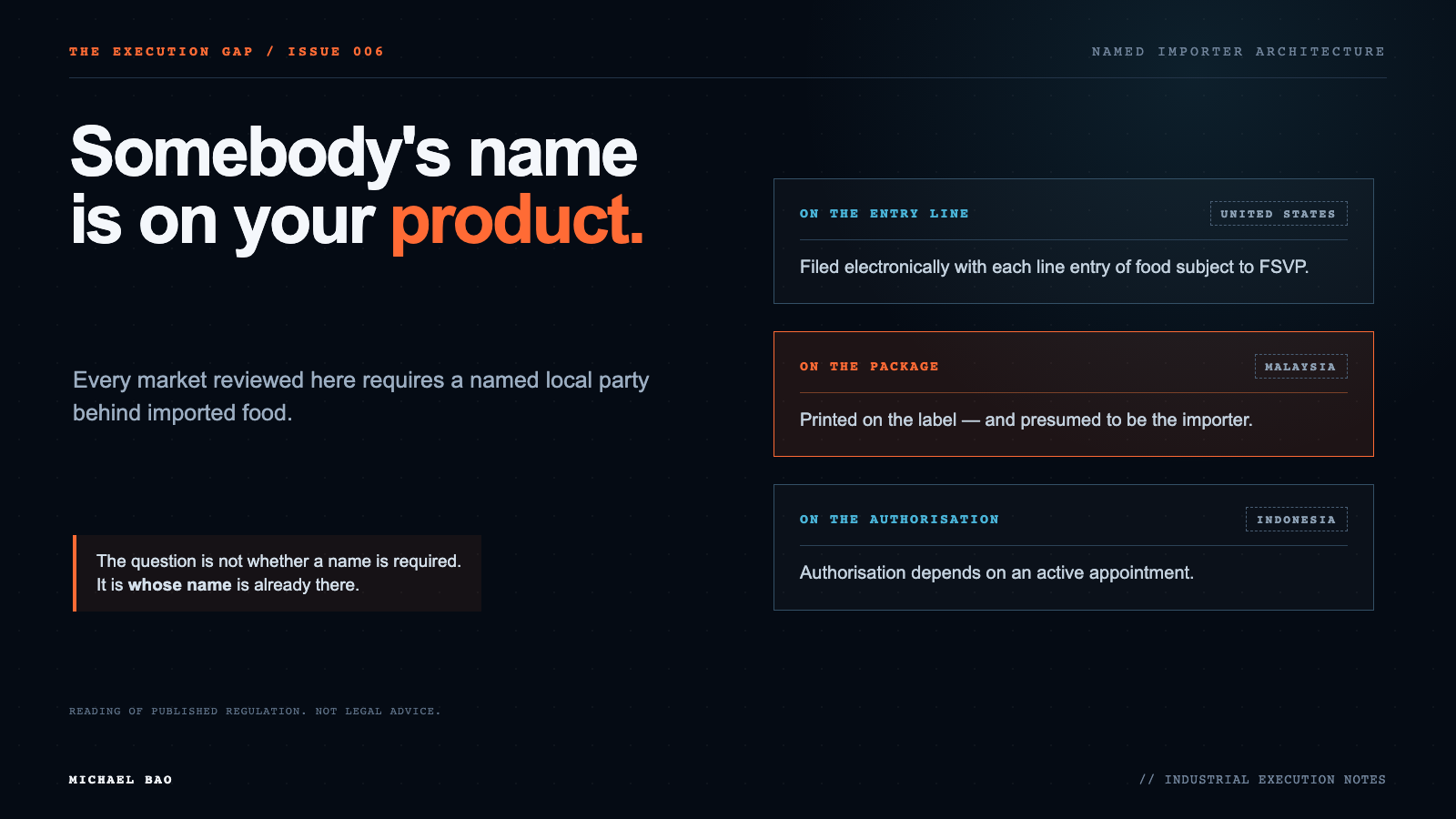
FDA says so inside Import Alert 99-41: "The FSVP importer may or may not also be the importer of record."
Two roles. One shipment. In my experience, it is common for no one at the brand to have checked which name went into which one.
That is not a US quirk. In every market reviewed here, a named, locally established party is required to stand behind imported food. What differs is what that name carries.
What follows is a reading of published regulation, not legal advice, and it says nothing about the propriety of any particular arrangement.
The Requirement Is The Same Everywhere. The Consequence Is Not.
Under 21 CFR 1.500, the FSVP importer is the US owner or consignee: the person in the United States who, at the time of entry, owns the food, has purchased it, or has agreed in writing to purchase it. If no such person exists at entry, the importer is the US agent or representative of the foreign owner or consignee, confirmed in a signed statement of consent. Under 1.509(a), that party's name, email address and unique facility identifier are filed electronically for each line entry of food subject to FSVP.
China writes the same idea in different words. Under GACC Order 249, food importers must file with the customs authority where they are domiciled, establish their own audit system for overseas exporters and manufacturers, and Customs supervises whether that audit activity is actually carried out.
The EU gets there by definition rather than by a dedicated importer clause. Import is a stage of production, processing and distribution; the persons responsible for it are food business operators. Imported food must comply with food law, operators must ensure and verify compliance for activities under their control, and every food business operator must notify the competent authority of each establishment under its control with a view to registration.
That importer is also the one who must withdraw the food from the market if it turns out not to comply. Three jurisdictions, three drafting traditions, one structure: a named local party, an obligation to verify rather than assume, and a regulator who checks the verifying.
Malaysia Prints The Name On The Package
Most markets keep the named party in a filing system. Malaysia puts it on the label and attaches liability to it.
The Food Regulations 1985 require that the label of imported food carry the name and business address of the importer in Malaysia and the country of origin. Under Section 28 of the Food Act 1983, where food involving a contravention is sold in an unopened package, any person who appears from a statement on the package to have imported the food is, unless the contrary is proved, deemed to have imported it and liable to the same penalty as if they had actually sold it.
Printed, then presumed. The burden of proof runs against whoever is named. In Malaysia, the answer to whose name is on this product? is not a records request. It is on the back of the pack, in a shop, right now.
The Fork: What The Name Carries
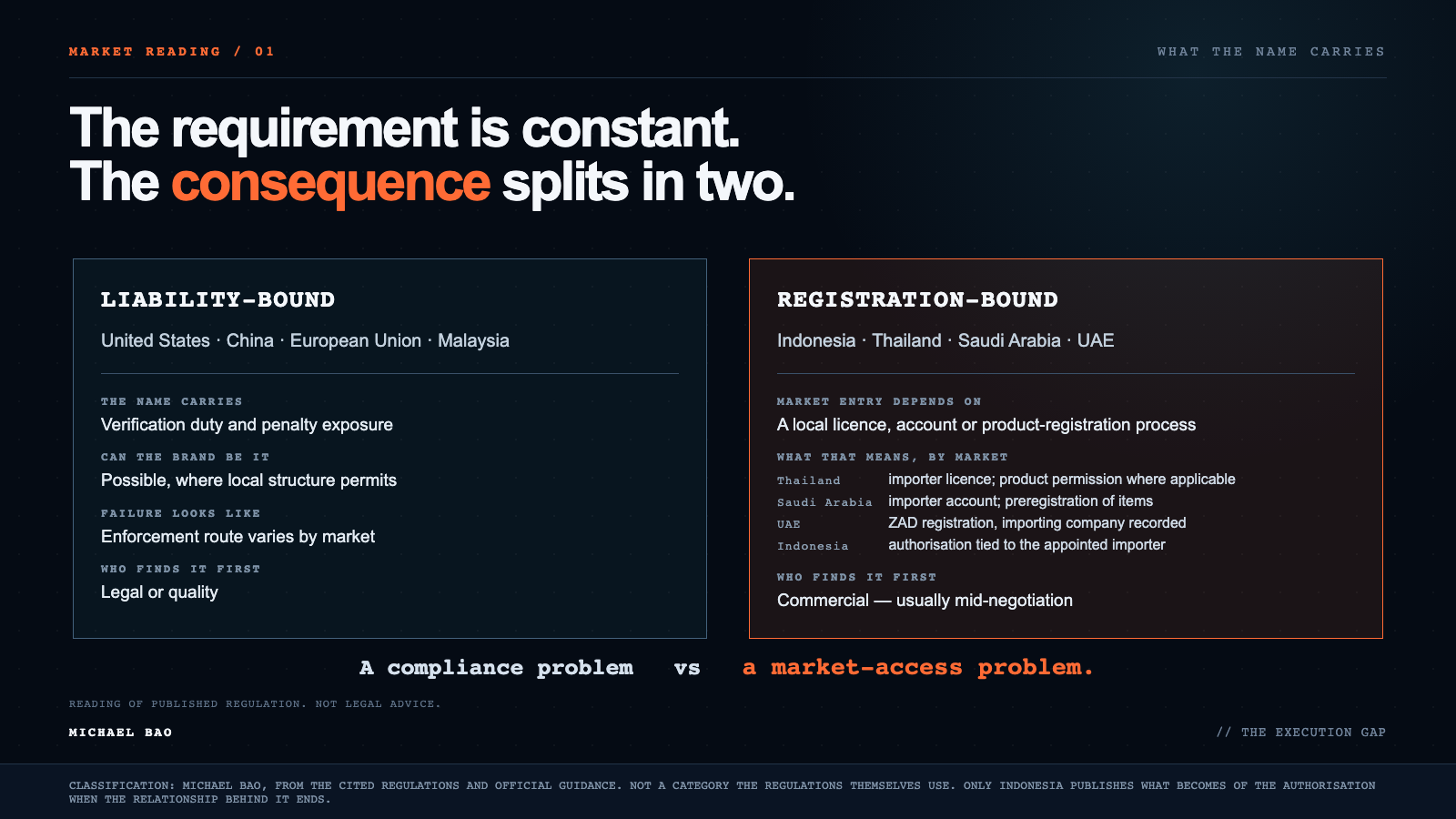
Across the eight markets reviewed here the requirement is constant, but the consequence divides into two groups. The grouping below is my classification, drawn from the cited regulations, not a category the regulations themselves use.
In liability-bound markets: the US, China, the EU, Malaysia: the named party carries a verification or food-law duty, with regulatory exposure. The enforcement route varies by market. The brand may be that party itself where the local structure permits it.
In registration-bound markets: Indonesia, Thailand, Saudi Arabia, the UAE: market entry depends on a local party's licence, account or product-registration process. Thailand requires a food importer to hold an import licence; Saudi Arabia requires the local importer to maintain the relevant Commercial Register and SFDA account; the UAE records the importing company through the ZAD registration route.
Liability-bound failures are a compliance problem. Registration-bound failures are a market-access problem. The second one is almost never discussed as compliance. It surfaces in a distributor negotiation.
Indonesia Writes The Ownership Problem Down
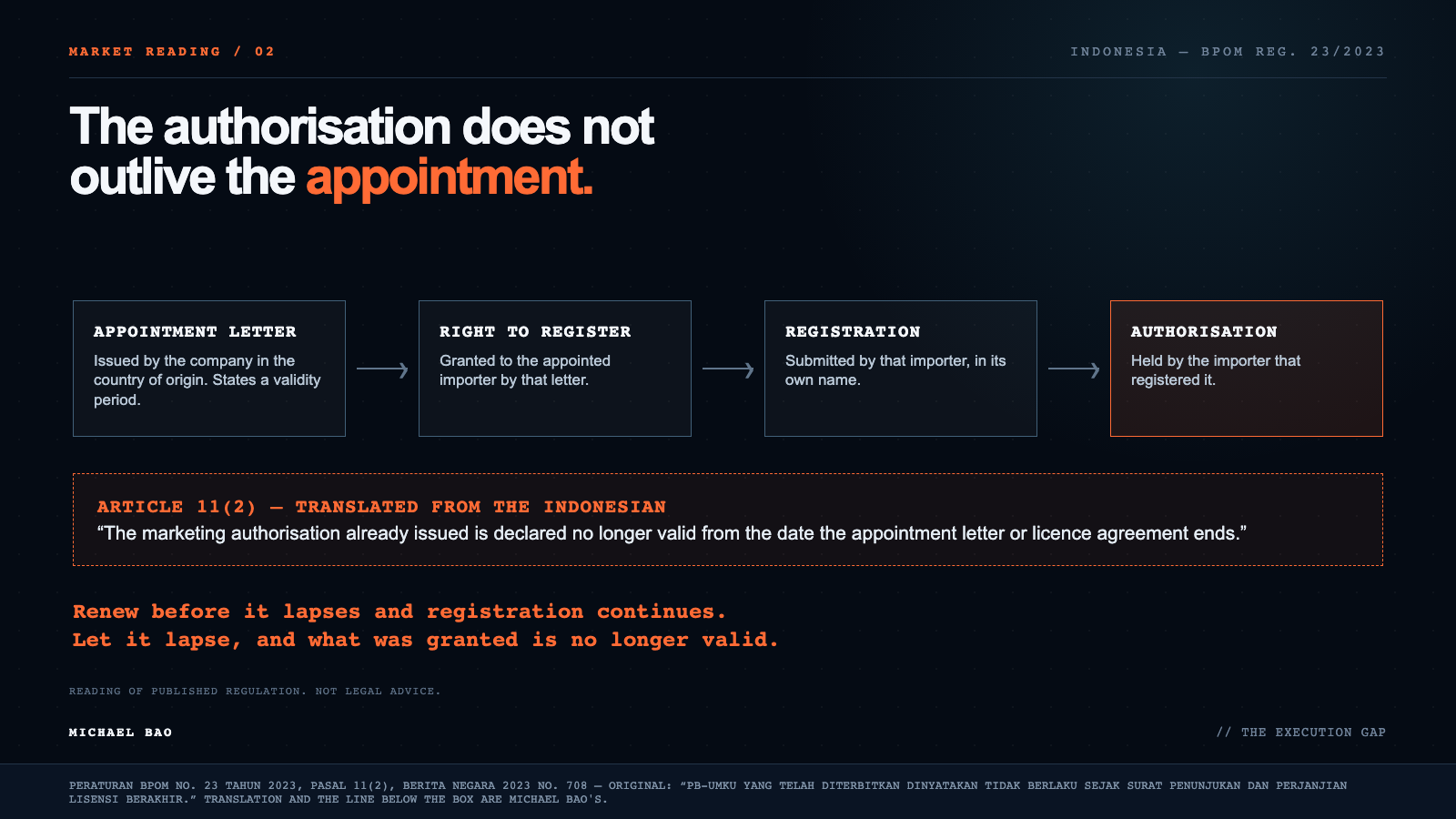
Indonesia is the market where this is fully drafted rather than implied. Under BPOM Regulation 23 of 2023, registration of imported processed food is submitted by the importer that has received an appointment from the company in the country of origin. The appointment letter must state the right granted to the appointed company to carry out registration and the period for which the appointment is valid.
So the right to register is a right the brand grants, in a document with an expiry date. Article 11 states the consequence: the company must notify BPOM when the appointment letter or licence agreement expires, and the marketing authorisation already issued is declared no longer valid from the date the appointment letter or licence agreement ends.
The supporting provisions hold the structure in place. The authorisation holder for imported food is the importer that carried out the registration. A change that alters the authorisation number requires a new registration. Where a non-exclusive appointment is disputed, registration cannot proceed until the dispute is fully settled. A dispute over the appointment itself, or over intellectual property, can reopen an authorisation already granted.
Read together, one sentence follows: in Indonesia, the authorisation does not outlive the appointment. Renew the letter before it lapses and the registration continues. Let it lapse, and what has already been granted is declared no longer valid.
This is where a registration question becomes an ownership question. Thailand, Saudi Arabia and the UAE share the entry condition; what they do not publish in comparable terms is what happens to the authorisation when the relationship behind it ends. That silence is not evidence that nothing happens. It means the question has to be asked locally, in the market's own language, before it matters rather than after.
What The Commercial Arrangement Is Selling
The commercial arrangement says: delivered duty paid, door to door: you do not have to handle the import.
The regulation says: a named, locally established party is answerable for this consignment, may be identified on every entry line, may be listed individually on an import alert, and in some markets holds your permission to sell.
These describe the same shipment. They are not incompatible. 21 CFR 1.500 expressly contemplates a foreign owner designating a US agent as the FSVP importer by signed consent, which is how compliant delivered-duty-paid arrangements are built. The problem is that the two are routinely assumed to align when nobody has checked that they do.
This is not an argument against delivered-duty-paid terms, overseas warehousing, or exclusive distribution. They solve real problems, and for many brands they are the only practical way to reach a market at all. The difficulty is narrower and more specific: the commercial value of those arrangements comes from absorbing something that the regulation assumes you are holding yourself.
The gap does not appear while things are going well. It appears on the day the relationship changes.
The Question Worth Asking This Quarter
For each market where the product is sold: who is the named party, and is that name yours or somebody else's?
- Which entity is filed or registered as importer in each market?
- Where is the document that appoints that entity, and when does it expire?
- Who holds the supplier-verification records that the named party is required to have?
- Which entity receives regulator correspondence when a question is raised?
None of this is legal advice, and none of it suggests any arrangement is improper. It is a documentation question, and in most cases counsel or a customs broker can answer it in an afternoon.
But if the first question takes longer than a day, the delay is itself the finding.
A contract can move the work. It cannot move the name.
Sources
- US Food and Drug Administration. Import Alert 99-41.
- Electronic Code of Federal Regulations. 21 CFR Part 1, Subpart L.
- General Administration of Customs of China. Order No. 249, Administrative Measures for Import and Export Food Safety, Articles 19, 22 and 23.
- Regulation (EC) No 178/2002, Articles 3, 11, 17 and 19; Regulation (EC) No 852/2004, Article 6.
- Food Act 1983 (Malaysia), Sections 28, 29 and 34; Food Regulations 1985, Regulation 11(1)(j).
- BPOM Regulation 23 of 2023 on Registration of Processed Food, Articles 9, 11, 34, 35, 40, 55 and 57.
- Food and Drug Administration, Thailand. Food import licence and product serial-number requirements.
- Saudi Food and Drug Authority. Imported-food requirements for Commercial Register, SFDA account and preregistration.
- UAE Ministry of Climate Change and Environment and Dubai Municipality. ZAD food product registration platform.