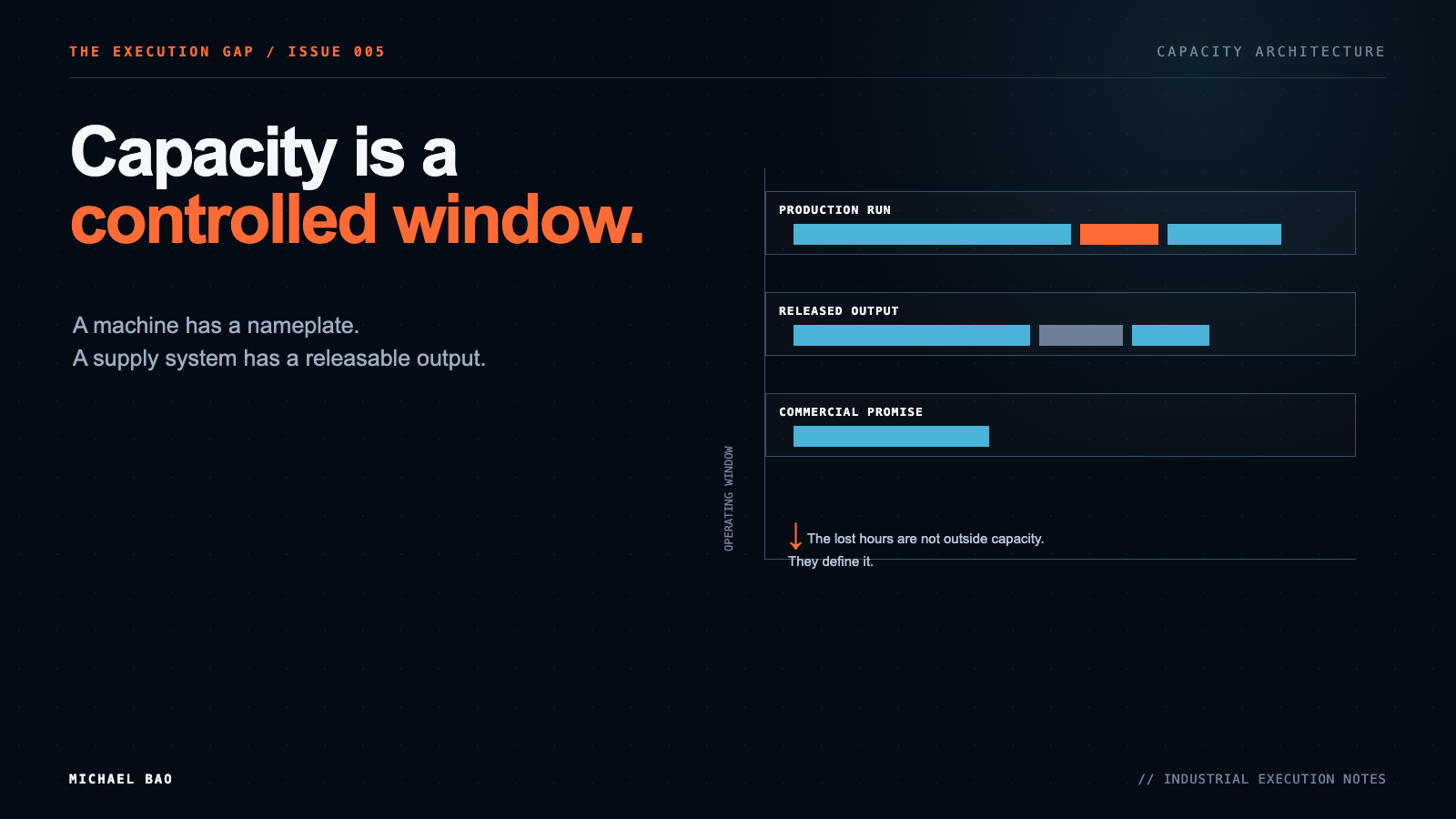
Most capacity plans begin with a machine. The difficult part begins after it is installed.
A plant can own the equipment, schedule the hours, and still be unable to produce a releasable product at the promised rate. Sanitation, changeovers, downstream constraints, quality holds, packaging transitions, and release rules are not interruptions around capacity. Together, they define it.
Three Capacity Numbers, Not One
Installed capacity is what equipment might process under a defined design condition. Scheduled capacity is what the operating plan assigns to it. Releasable capacity is what the whole system can repeatedly produce, document, release, and deliver.
Only the third number is commercial capacity. If a line can fill 20,000 units per hour but loses a shift to sanitation, waits for a laboratory result, runs out of a qualified packaging component, or creates downstream rework, its nameplate speed has not become supply. It has become a planning assumption.
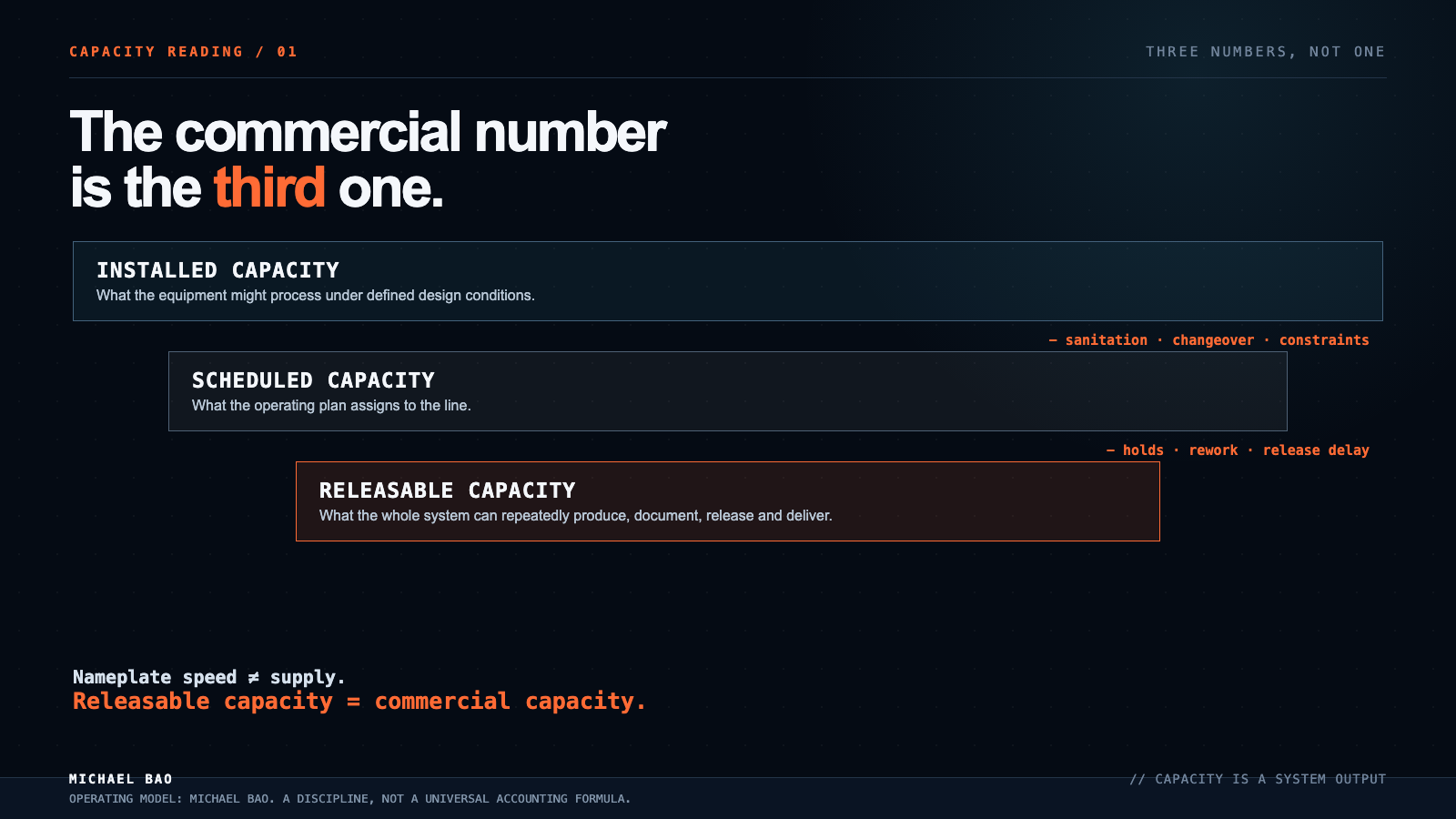
The discipline is straightforward: make every subtraction visible before a commercial promise is made. Nameplate capacity, minus sanitation and changeover windows, process bottlenecks, and hold, rework, and release delay, becomes usable repeatable capacity.
A Bottleneck Is a Chain Property
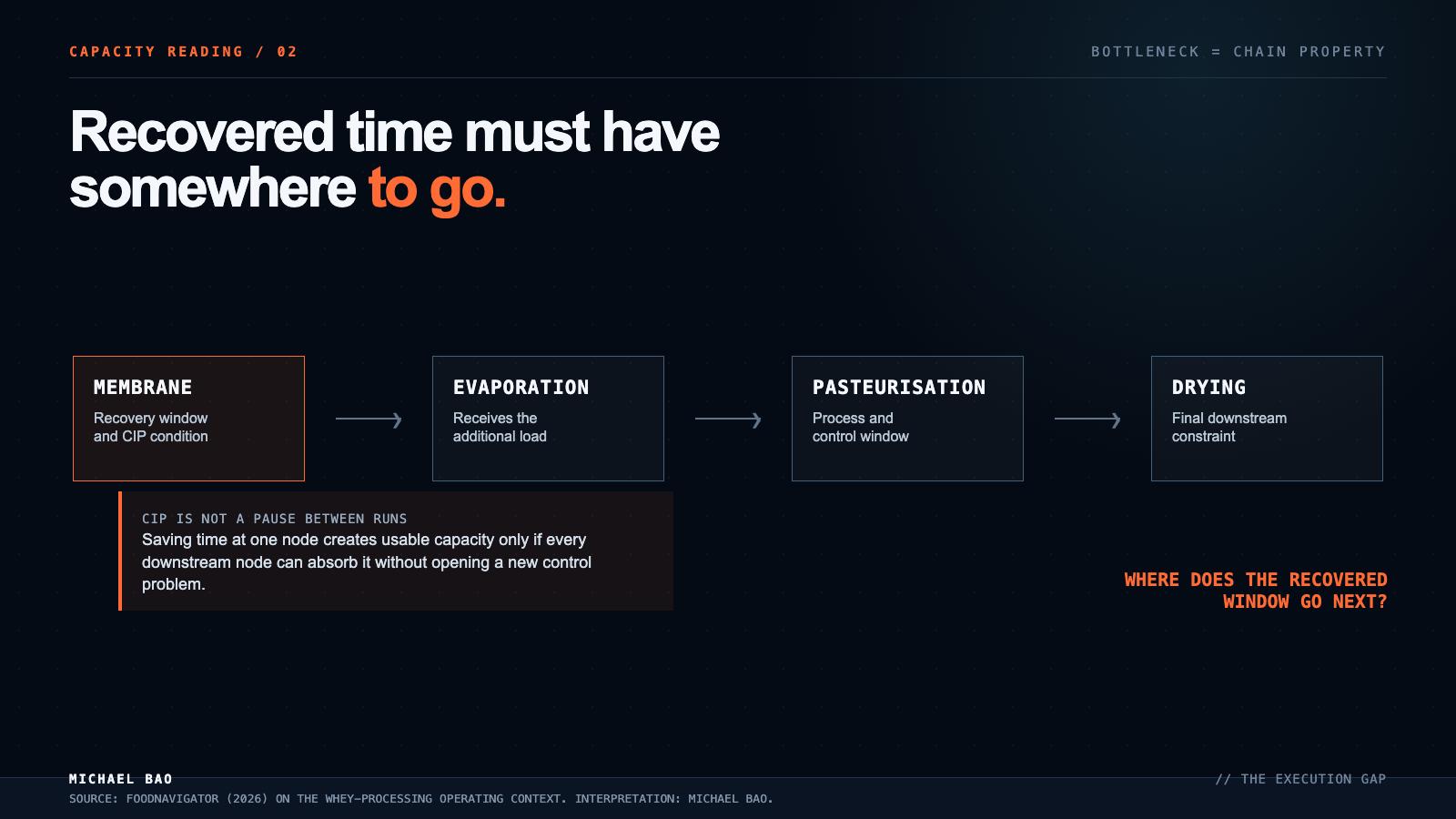
FoodNavigator's July reporting on whey processing described capacity as a chain running through membrane concentration, evaporation, pasteurisation, and drying rather than one standalone machine.[1] The operating context reported systems running for more than 20 hours a day and 15 to 45 minutes saved per CIP cycle.
Those minutes matter. They do not automatically become sellable WPC80 or WPI. If evaporation, pasteurisation, or drying cannot absorb the recovered window, the constraint has only moved. The central capacity mistake is treating a local improvement as a system improvement.
Cleaning Is Part of the Production Architecture
CIP is often classified as downtime because no saleable unit leaves the line while it runs. That classification is operationally misleading. Cleaning determines when the next qualified run can begin; it affects membrane condition, changeover readiness, microbiological control, and schedule reliability.
The implication is not that every CIP should be shorter. Its duration, chemistry, verification, and downstream consequences belong inside capacity planning. A faster cycle that compromises cleaning effectiveness is not recovered capacity. It is deferred risk.
Installed Capability Is Not Application Capacity
Happy Plant Protein and Crespel & Deiters announced a commercial-scale dry-extrusion collaboration in July. Their public material describes one-step dry extrusion, application development, and commercial production at the Helmond facility.[2][3]
That is meaningful progress. It does not mean every target SKU has the same usable capacity. A node can be commercially capable in the abstract and still be constrained by qualified formulations, raw-material windows, changeover time, cleaning validation, packaging compatibility, and release conditions. The qualified production window is the asset.
Support Systems Decide Whether the Machine Remains Usable
Alfa Laval's July Food & Pharma Division announcement connects separation, heat transfer, fluid handling, application testing, and service support into a single capability proposition.[4] The announcement does not prove a customer outcome. It illustrates that capacity does not sit inside metal alone.
Documentation, application trials, spare-part continuity, service response, and process knowledge decide whether equipment remains inside its qualified window. A plant with installed equipment but no reliable support ecosystem owns a theoretical asset with an uncertain operating life.
Variety Consumes Capacity
Commercial teams usually experience packaging, delivery format, and SKU proliferation as growth. Operations experience them as additional coordination.
A new pack can require material qualification, artwork control, supplier approval, setup verification, inspection, and release handling. A new delivery format can introduce different water activity, depositing, drying, filling, sealing, and sanitation requirements. Neither is inherently negative. Both consume production windows.
The question for a new SKU is not only whether the line can technically make it once. It is whether the system can make it without degrading the reliability of the other SKUs already paying for the line.
Monitoring Protects Capacity; It Does Not Create It
Monitoring creates visibility. Testing produces an analytical result. Certification provides evidence within a defined scope. Release requires an interpretation rule, an accountable owner, and a controlled response.
These layers can prevent nonconforming material from becoming market supply. That is how they protect usable capacity. They do not create nameplate throughput. When designed late, they can instead create avoidable holds, rework, and release queues. The remedy is not to weaken them; it is to include them in the capacity architecture from the beginning.
The Verdict
Capacity is not the maximum a machine can make. It is the amount a complete system can make, release, and supply repeatedly while control remains intact.
- Which hours are genuinely productive, rather than merely scheduled?
- Where does recovered time go next?
- Which release, sanitation, or changeover condition can consume that time again?
- Can the system repeat the result at commercial volume?
If the answer stops at installed equipment, the capacity plan has not reached the operating system yet.
Fact-Check Sources
- FoodNavigator. (2026, July 13). Inside the whey protein bottleneck: How processors can find more capacity. Capacity-context reporting; operating interpretation by Michael Bao.
- Happy Plant Protein. (2026, July 9). Happy Plant Protein partners with Crespel & Deiters to bring technology to commercial scale.
- Crespel & Deiters. (2026). Extrusion technology for functional textures. Public capability context; not evidence of completed SKU-specific qualification.
- Alfa Laval. (2026, July 15). Alfa Laval deepens its commitment to the global food industry with new Food & Pharma Division.