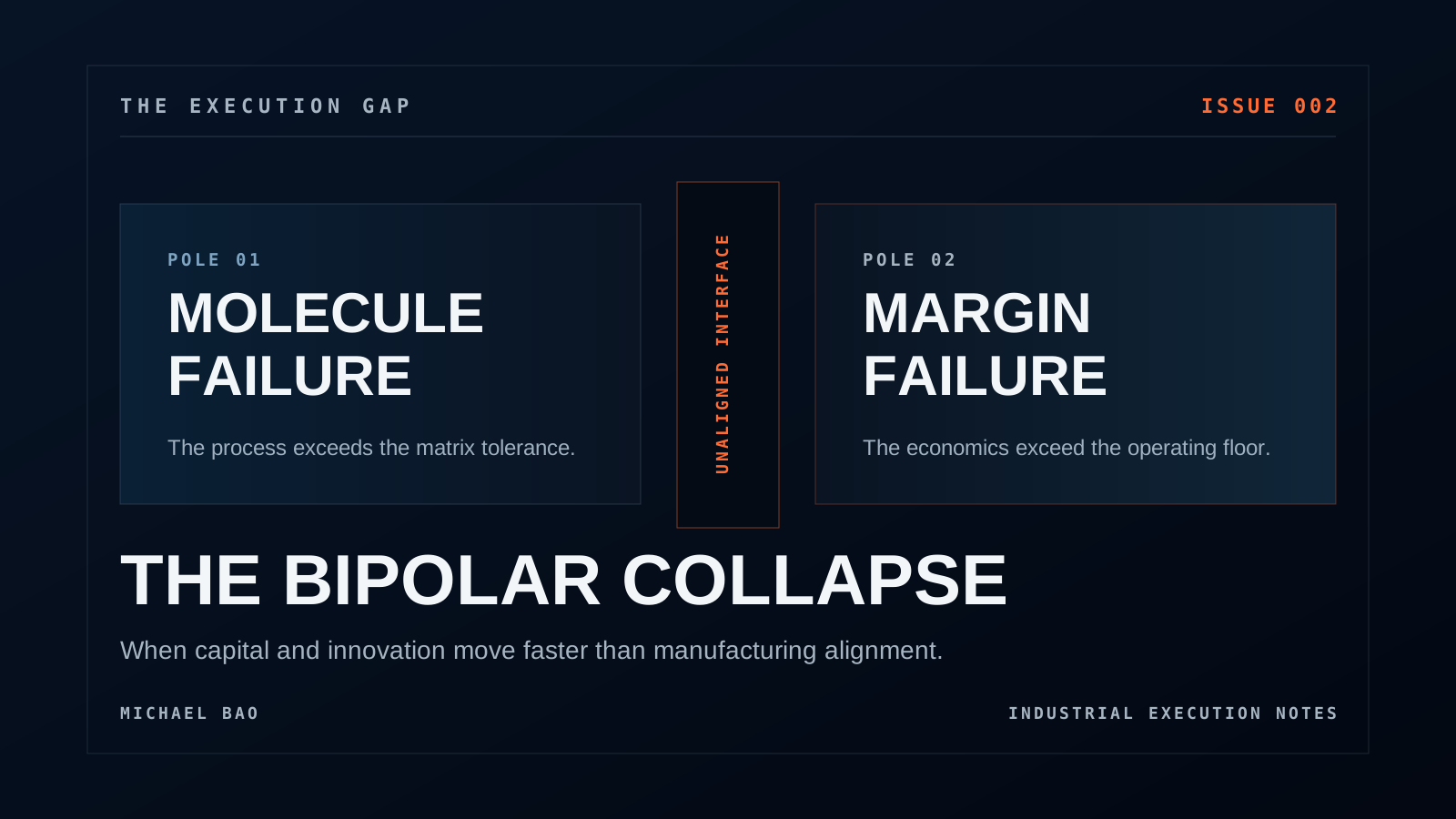
Capital can fund a molecule, acquire a brand, and open distribution. It cannot make a heat-sensitive matrix tolerate the wrong thermal profile. It cannot make an expensive process become economical merely because demand increases.
This is the Bipolar Collapse: an execution system that breaks either the product or the margin because the commercial architecture and physical architecture were designed separately.
The Two Poles of Collapse
The symptoms differ, but the structural cause is the same: the operating window was never aligned with the commercial requirement.
The Molecule Fails
Heat, shear, residence time, pH, oxygen, water activity, or packaging exposure push the product outside its validated tolerance. The result may be fouling, separation, flavour drift, texture loss, or shortened shelf life.
The Margin Fails
The target price cannot carry the real requirements of the product: specialised inputs, slow changeovers, yield loss, sanitation time, freight, packaging, or a narrow production window.
Innovation Does Not End at the Molecule
Established fact: 21st.BIO describes its work as supporting precision-fermentation development from strain, fermentation, and purification work through pilot production, scale-up guidance, and support toward industrial-scale manufacturing. Its public materials distinguish laboratory and development work from the separate work required to reach industrial-scale production.
Michael Bao's inference: the same separation exists when a novel ingredient enters a finished food or beverage. The ingredient may be valid, while the selected UHT line, mixing sequence, downstream purification, packaging barrier, or cost structure remains unqualified for the intended product.
Thermodynamic Parity Index thinking is useful here as a diagnostic lens. It asks whether the thermal and mechanical stress imposed by the target node overlaps with the tolerance window of the product matrix. It is not a substitute for a validated process study, and it should not be presented as one.
Portfolio Scale Creates an Integration Workload
Established fact: Celsius Holdings reported that its first-quarter 2026 gross margin was 48.3%, compared with 52.3% a year earlier. The company attributed the change to the addition of Alani Nu and Rockstar Energy, both of which had lower margin profiles when acquired. It also described active work on raw-material alignment, freight, price-pack architecture, and portfolio integration.
That disclosure does not prove a manufacturing failure. It shows something more useful: adding brands changes the operating system. Margin, distribution, purchasing, freight, pack architecture, and product mix have to be integrated; portfolio scale is not a simple copy-and-paste of the original brand model.
Michael Bao's inference: acquisition value is exposed whenever the integration model assumes that distinct products can share the same node, schedule, cost structure, and release logic without requalification.
The Alignment Stack
The bipolar failure is prevented before scale by connecting four decisions that are often made in different rooms.
Product Window
What must remain true for identity, safety, sensory quality, and shelf life?
Process Window
Which thermal, mechanical, timing, cleaning, and packaging conditions preserve it?
Node Capability
Can the selected equipment and operating team reproduce that window at throughput?
Economic Floor
Can yield, changeovers, materials, logistics, and quality controls fit the market price?
What the Model Changes
The useful question is not whether capital is moving too fast, or whether novel ingredients are too fragile. Both can succeed. The question is whether the investment thesis and product thesis have been translated into a controlled production thesis.
- Do not treat a molecule milestone as proof of finished-product robustness.
- Do not treat installed capacity as usable capacity until the process window is repeatable.
- Do not treat distribution reach as integration completion.
- Do not ask procurement to solve a physical mismatch through price negotiation.
- Name one owner for the interfaces between formulation, manufacturing, packaging, release, and unit economics.
The two poles are avoidable. But only if the system is designed before one side is forced to absorb the mismatch.
Strategy is the commercial intent. The supply chain is the grounded reality.
Fact-Check Sources
- 21st.BIO — Precision Fermentation Offering. Public description of strain and process development, pilot production, scale-up guidance, and industrial manufacturing support.
- Celsius Holdings — First Quarter 2026 Financial Results. Portfolio revenue, gross margin, acquisition profiles, and integration initiatives.
- Celsius Holdings and PepsiCo — Strategic Partnership. Alani Nu distribution transition and Rockstar Energy acquisition structure.