Today, the industry can point to an EU-authorised mycelium ingredient, commercial-scale dry extrusion, animal-free specialty fats, and expanded processing capacity.[1][2][4][5]
These are genuine signs of progress. But the commercial question has changed.
The question is no longer only: can a new protein be created?
It is: can that ingredient move through regulation, formulation, manufacturing, packaging, distribution, and repeat purchase without losing the reason it was selected?
Four Integration Tests
The alternative-protein industry is entering a phase in which innovation has to pass four connected tests.
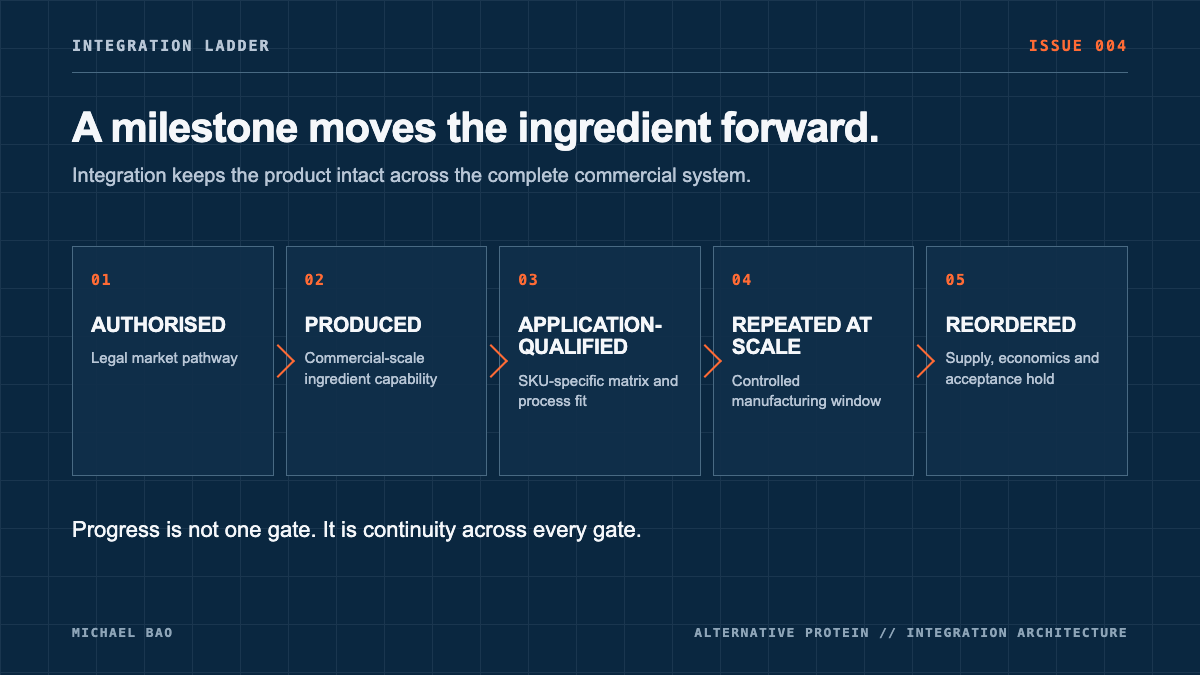
1. Regulatory Permission Is Not Commercial Readiness
On 3 July, the European Commission adopted Regulation (EU) 2026/1507, authorising Rhizomucor pusillus mycelium as a novel food under specified uses and labelling conditions. The regulation takes effect on 26 July 2026 and sets out the applicable five-year data-protection provisions and exceptions.[1]
That is a substantial milestone following a multi-year regulatory process. It creates a defined EU market route under the authorised specifications, uses, labelling conditions, and data-protection terms.
But authorisation answers a bounded question: whether the ingredient may be placed on the market under those conditions. It does not choose the right product format, qualify a co-manufacturer, establish the sensory target, select the packaging system, or prove the channel economics.
Permission removes one barrier. Integration still has to connect that permission to a product people can buy again.
2. Commercial-Scale Ingredient Capability Is Not Qualification in Every Finished-Product System
Happy Plant Protein and Crespel & Deiters have moved one-step dry extrusion into commercial-scale production at the Helmond facility in the Netherlands.[2]
According to Happy Plant Protein, the resulting textured vegetable protein (TVP) is designed to improve taste and aroma, reduce bitter and beany off-notes, and allow texture and functionality to be tailored for meat analogues, hybrid products, ready meals, and snacks.[2]
Crespel & Deiters' public materials describe application-development and implementation support alongside extrusion technology.[3] Those disclosed capabilities should be recognised. The cited public materials, however, do not establish that every application step has been completed for the Happy Plant Protein ingredient in any particular finished-product SKU.
A meat analogue, ready meal, and protein snack impose different hydration, texture-retention, flavour, cooking, packaging, shelf-life, and release requirements. The supplier may provide a capable ingredient and a strong application pathway. The receiving product system still has to define acceptance for that SKU.
Commercial scale opens the integration pathway. It does not make every application interchangeable.
3. Ingredient Performance Has to Survive the Food Matrix
Mondelēz International selected nine companies from more than 200 applicants for its 2026 CoLab Tech programme. The cohort was organised around sustainability, ingredient science, food technology, packaging, and production efficiency.[4]
One selected company, Nourish Ingredients, is developing animal-free specialty fats through precision fermentation and enzyme processes.[4]
That matters because protein is often treated as the category headline while the finished eating experience is governed by a wider system. Fat, protein, and polysaccharide systems jointly shape the texture and flavour of plant-based meat analogues.[7] For product development, formulation, processing conditions, packaging, distribution, and preparation should be assessed as part of that system.
The relevant unit is not the isolated ingredient claim. It is the performance of the complete food matrix after processing and at the end of shelf life.
4. Capacity and Unit Economics Have to Be Designed Together
Schouten Europe acquired Bobeldijk Food Group in June, explicitly linking the transaction to increased production capacity, flexibility, and further investment in innovation. Schouten also reported revenue growth of more than 30% in the preceding year.[5]
This is what sector maturity begins to look like: capacity is no longer an abstract promise attached to future demand. It becomes an operating asset that companies acquire, configure, and govern.
Christie Lagally Bradburn, founder and CEO of Rebellyous Foods, frames the challenge as product-market-technology fit: product acceptance, market response, production technology, and the path to profitability must align.[6] One implication is that higher production volume alone may not correct an underlying cost mismatch.
More volume is not automatically better integration. A 2022 review identified sensory performance and reliable, robust processing as recurring challenges in meat analogues.[8] If a product requires an expensive isolate, narrow process window, high labour input, slow changeovers, difficult sanitation, or a packaging system that erodes margin, greater demand may amplify the mismatch rather than solve it.
Capacity becomes strategic only when it can produce an acceptable outcome repeatedly, at a cost the market can carry.
The Missing Role Is Integration Ownership
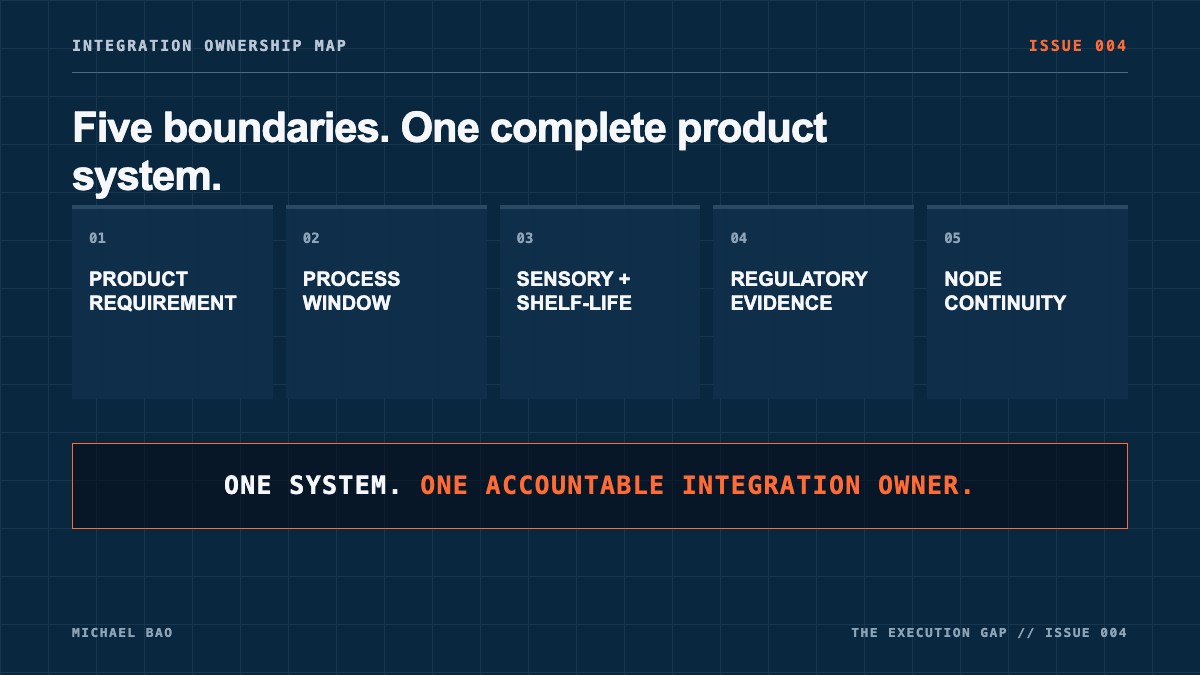
Alternative-protein projects often have many contributors but no explicit owner of integration.
The ingredient company owns the ingredient specification. The product developer owns the bench formula. The regulatory adviser owns the dossier and claim boundary. The manufacturer owns the line and operating procedures. The packaging supplier owns the material specification. The commercial team owns the launch date and price architecture.
Each party can complete its own work while the complete product system lacks an explicit integration owner.
Before treating an alternative-protein programme as commercially ready, assign one accountable owner to each of the five boundaries below.
- The target-product specification: what the consumer and business must actually receive.
- The process window: which thermal, mechanical, hydration, mixing, forming, filling, and sanitation conditions keep the product inside that specification.
- The sensory and shelf-life acceptance boundary: what must remain true after manufacture, distribution, storage, preparation, and consumption.
- The regulatory evidence boundary: what is authorised, substantiated, labelled, and market-specific.
- The manufacturing-node continuity: which supplier and production changes must become visible before they alter the product.
Without that owner, each handoff can look complete while the system between the handoffs remains fragile.
This is where The Execution Gap appears. Not because the science failed. Because no one was accountable for keeping the science intact across the commercial system.
What the Integration Phase Changes
The next phase of alternative protein will still produce new organisms, proteins, fats, structures, and processing methods. But novelty alone will carry less information.
The stronger signal will be whether a company can show:
- a lawful market pathway;
- an ingredient with defined functional and sensory behaviour;
- an application method that survives the intended product matrix;
- a manufacturing window that remains controlled at commercial throughput;
- capacity and economics that support repeat supply;
- and a clear owner for the interfaces between them.
Regulatory approval is not dismissed. It is placed in the system. Commercial production is not questioned for the sake of scepticism. It is connected to application qualification. Ingredient functionality is not reduced to a specification sheet. It is tested in the complete food. Capacity is not celebrated only as installed volume. It is judged as repeatable, usable supply.
The sector does not need less innovation. It needs innovation that arrives with an integration architecture.
For many companies, the next competitive advantage may not be another protein.
It may be ownership of the system that makes the protein commercially repeatable.
Strategy is the commercial intent. The supply chain is the grounded reality.
Fact-Check Sources
- [1] European Commission. Regulation (EU) 2026/1507. Authorisation, effective date, uses, labelling conditions, and data-protection boundary for Rhizomucor pusillus mycelium.
- [2] Happy Plant Protein. (2026, July 9). “Happy Plant Protein Partners with Crespel & Deiters to Bring Technology to Commercial Scale.” Helmond production, supplier positioning, and intended applications.
- [3] Crespel & Deiters. (2026). “Extrusion Technology for Functional Textures.” Public description of application-development and implementation support; not evidence of completed SKU-specific qualification.
- [4] Mondelēz International. (2026, June 16). “Nine Start-Ups Chosen to Participate in CoLab Tech 2026.” Cohort scope, applicant count, and Nourish Ingredients attribution.
- [5] Schouten Europe. (2026, June 24). “Schouten Europe Acquires Bobeldijk Food Group.” Capacity, flexibility, innovation, and reported revenue-growth context.
- [6] Bradburn, Christie Lagally. (2026, June 26). “Seeking Alt-Meat’s Product-Market-Technology Fit.” Protein Production Technology International.
- [7] Jang, J., & Lee, D.-W. (2024). “Advancements in Plant-Based Meat Analogs Enhancing Sensory and Nutritional Attributes.” npj Science of Food, 8, 50.
- [8] Chen, Y. P., Feng, X., Blank, I., & Liu, Y. (2022). “Strategies to Improve Meat-Like Properties of Meat Analogs Meeting Consumers’ Expectations.” Biomaterials, 287, 121648.