What The Signal Actually Says
Happy Plant Protein and Crespel & Deiters announced a collaboration to bring one-step dry-extrusion technology to commercial-scale production at the Helmond facility in the Netherlands.[1] Alfa Laval's July Food & Pharma Division announcement similarly presents separation, heat transfer, fluid handling, application testing, and service support as connected food-production capabilities.[2]
These announcements describe capability and investment. They do not establish a particular customer's capacity outcome. This advisory uses them as public context for a narrower operating distinction: installed equipment is necessary, but it is not by itself a releasable commercial output.
Why This Matters In SVA Terms
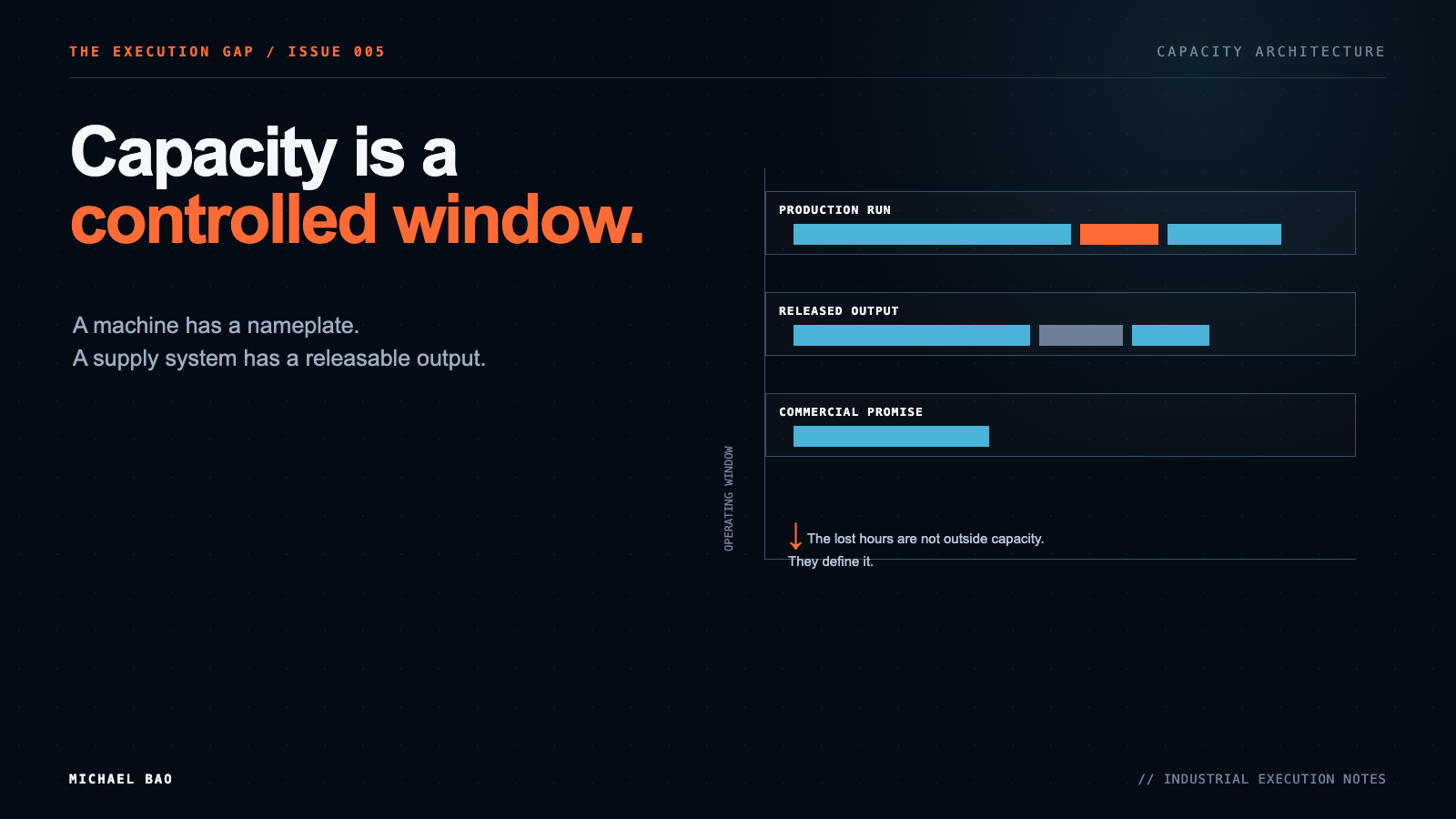
The commercial capacity number is not the maximum a machine might achieve under a defined design condition. It is the output a complete system can repeatedly produce inside specification, document, release, and deliver.
Sanitation windows, changeovers, raw-material availability, packaging qualification, downstream bottlenecks, laboratory holds, rework, and release rules all consume the same operating window that sales plans often count as available capacity. The advisory's capacity model is an operating discipline, not a universal accounting formula.
What A Briefing Would Focus On
A focused review would separate installed, scheduled, and releasable capacity; locate the next receiving constraint after any local improvement; and make release, sanitation, changeover, and support-system dependencies visible before a commercial promise is made. The goal is to stop borrowing control from the next batch to meet this one.
Plan Against The Capacity You Can Release.
A focused SVA briefing can map which technical and release conditions convert installed throughput into repeatable commercial supply.
Request Briefing